

![[GRADE A] DAYTON AUDIO ND140-8 Speaker Driver Midbass / Midrange Aluminium 40W 8 Ohm 84.5dB 54Hz - 8000Hz Ø13.3cm](https://www.audiophonics.fr/72931-thumb_default/dayton-audio-nd140-8-speaker-driver-midbass-midrange-aluminium-40w-8-ohm-845db-54hz-8000hz-o133cm-sba.jpg)
![[GRADE A] DAYTON AUDIO DSA215-8 Speaker Driver Woofer 80W 8 Ohm 89dB 35Hz - 7000Hz Ø20cm](https://www.audiophonics.fr/72887-thumb_default/dayton-audio-dsa215-8-speaker-driver-woofer-80w-8-ohm-89db-35hz-7000hz-o20cm.jpg)
![[GRADE S] TOPPING ARPEGEAR HANE In-Ear Monitors IEM Dynamic 80 Ohm 115dB 5Hz-35kHz](https://www.audiophonics.fr/66633-thumb_default/topping-arpegear-hane.jpg)
![[GRADE S] ETI LINK SPADE Spades Gold Plated Tellurium Copper Ø9mm (Set x4)](https://www.audiophonics.fr/66011-thumb_default/eti-link-spade-spades-gold-plated-tellurium-copper-o9mm-set-x4.jpg)






13% higher voltage.
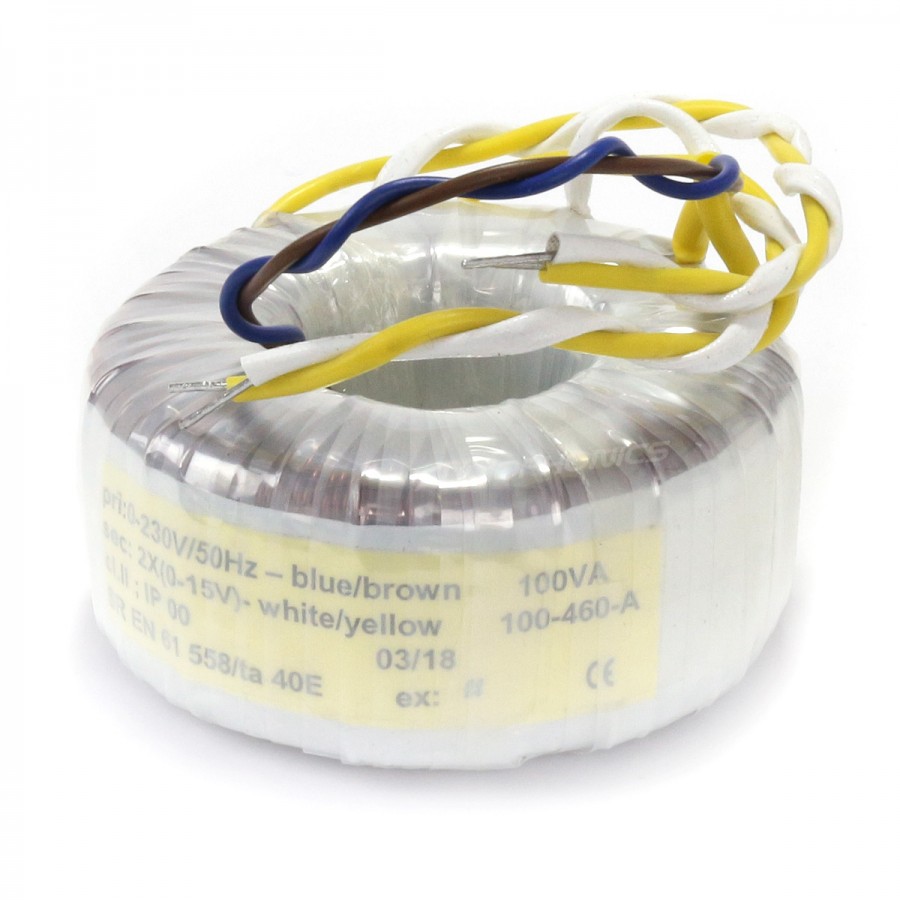
I purchased this 100VA toroidal transformer with 2×15V secondary (3.3A) for a linear power supply in an audio project. Mechanically the transformer looks good: neatly wound, compact, and it operates silently without any audible mechanical hum. Installation is straightforward and the wiring is clearly identified.
However, what I noticed is that the output voltage is noticeably higher than specified. Instead of the rated 2×15V AC, I measure approximately 2×17V AC with no load. That is about 13% higher than the nominal voltage.
To be fair, this behavior is not completely unusual for transformers. Many transformers are specified at their nominal load, and when measured without load the voltage can be significantly higher. Still, 17V instead of 15V is quite a large deviation, especially if the transformer is intended for power supplies that rely on accurate secondary voltages.
After rectification and smoothing this results in roughly ±23–24V DC, which can increase heat dissipation in linear voltage regulators and may not be ideal for circuits designed around a typical ±15V supply.
Pros
✔ Solid build quality
✔ Compact size
✔ No mechanical hum or vibration
✔ Sufficient power capacity (100VA)
Cons
✖ Output voltage significantly higher than specified (≈17V instead of 15V)
✖ Can cause extra heat in linear regulator circuits
⭐ Conclusion
Overall the transformer appears well built and works fine electrically, but the higher-than-expected no-load voltage should be taken into account when designing a power supply. If your design requires tighter voltage margins, you might want to consider a 2×12V or 2×14V transformer instead.
This review has been posted for Toroidal Transformer 100VA 2x15V 3.3A I purchased this 100VA toroidal transformer with 2×15V secondary (3.3A) for a linear power supply in an audio project. Mechanically the transformer looks good: neatly wound, compact, and it operates silently without any audible mechanical hum. Installation is straightforward and the wiring is clearly identified.
However, what I noticed is that the output voltage is noticeably higher than specified. Instead of the rated 2×15V AC, I measure approximately 2×17V AC with no load. That is about 13% higher than the nominal voltage.
To be fair, this behavior is not completely unusual for transformers. Many transformers are specified at their nominal load, and when measured without load the voltage can be significantly higher. Still, 17V instead of 15V is quite a large deviation, especially if the transformer is intended for power supplies that rely on accurate secondary voltages.
After rectification and smoothing this results in roughly ±23–24V DC, which can increase heat dissipation in linear voltage regulators and may not be ideal for circuits designed around a typical ±15V supply.
Pros
✔ Solid build quality
✔ Compact size
✔ No mechanical hum or vibration
✔ Sufficient power capacity (100VA)
Cons
✖ Output voltage significantly higher than specified (≈17V instead of 15V)
✖ Can cause extra heat in linear regulator circuits
⭐ Conclusion
Overall the transformer appears well built and works fine electrically, but the higher-than-expected no-load voltage should be taken into account when designing a power supply. If your design requires tighter voltage margins, you might want to consider a 2×12V or 2×14V transformer instead.


 English
  Français